Latest news and updates from DSML Kazakhstan community
Stay up to date with the latest events
Admission to NU is not based on UNT results. Applicants must take the international SAT or the university's NUET exam and submit an IELTS overall score of at least 6.5, with a minimum of 6.0 in each section.
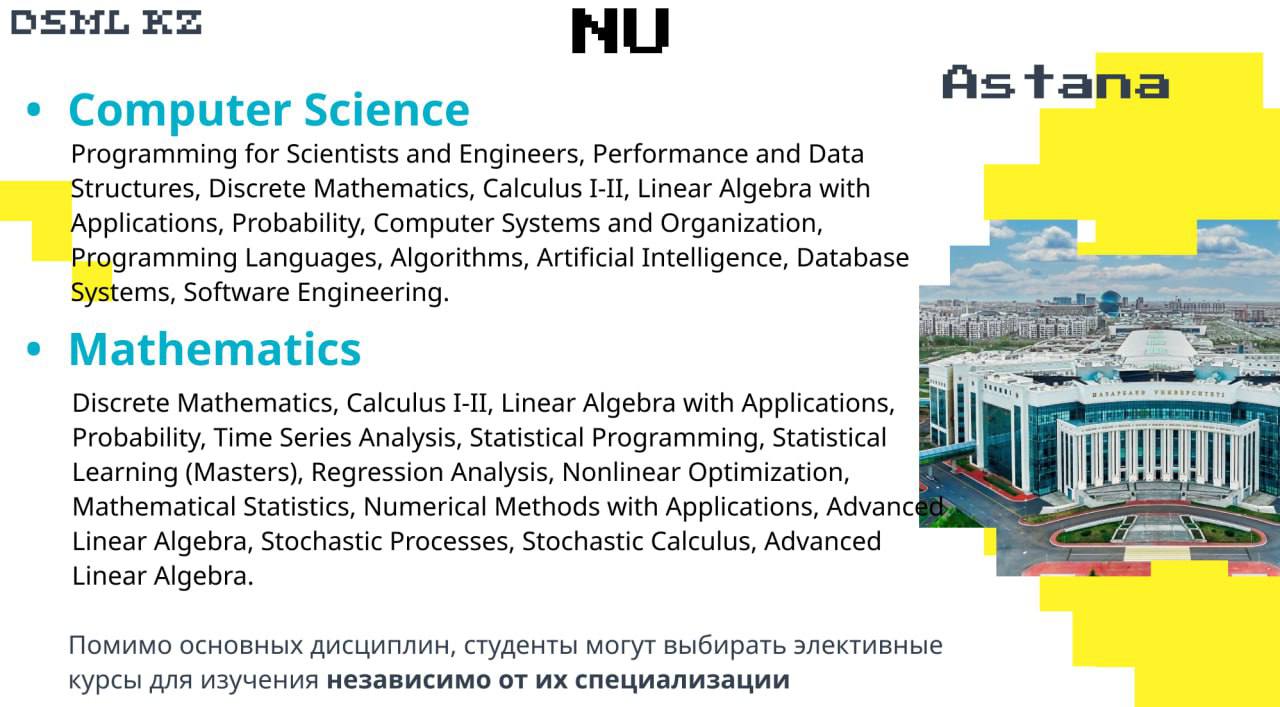
We selected two programs at NU:
Average applicant: IELTS 7.3; SAT Reasoning 1443. The program places greater emphasis on computer science fundamentals and partly covers data science. Core courses: Programming for Scientists and Engineers; Performance and Data Structures; Discrete Mathematics; Calculus I–II; Linear Algebra with Applications; Probability; Computer Systems and Organization; Programming Languages; Algorithms; Artificial Intelligence; Database Systems; Software Engineering.
Average applicant: IELTS 7.2; SAT Reasoning 1395. The program focuses on mathematical foundations and proofs of theories underlying data science. Core courses and electives: Discrete Mathematics; Calculus I–II; Linear Algebra with Applications; Probability; Time Series Analysis; Statistical Programming; Statistical Learning (Master's); Regression Analysis; Nonlinear Optimization; Mathematical Statistics; Numerical Methods with Applications; Advanced Linear Algebra; Stochastic Processes; Stochastic Calculus; Advanced Linear Algebra.
Alongside their core subjects, students can take electives from different departments—including Computer Science, Political Science, Economics, and Nursing—regardless of their major.
Tuition information: Most students study on grants, but paid study is also available at NU. Bachelor's programs cost approximately 9,039,000 tenge, or $23,000, per year.
Great news from Kazakhstani startup Cerebra. The company, which develops AI for neuroradiology and provides automated diagnosis of ischemic and hemorrhagic stroke, was invited to join MedTech Innovator, the largest international medical-technology accelerator.
MedTech Innovator is more than a leading medtech startup accelerator: it aims to improve patients' quality of life by supporting and developing companies that are transforming healthcare. The accelerator's portfolio already includes 509 graduates, more than 200 FDA approvals and clearances, and approximately $6.8 billion in project funding.
Through the accelerator, Cerebra received mentorship from Zimmer Biomet, a global medical-equipment company with more than a century of history.
Cerebra founder Doszhan Zhusupov nevertheless emphasizes the need for greater support at home. We hope the company's future success becomes an important example for Kazakhstan's IT community and encourages stronger government involvement in supporting innovative projects.
UNT subjects: Mathematics + Computer Science. The minimum UNT score to apply for a grant is 80.
The program places greater emphasis on mathematics and data analysis. Core courses: Calculus (1, 3); Linear Algebra; Discrete Maths; Ordinary Differential Equations; ICT Algorithms and Programming (1, 2); Database Management Systems (1, 2); Intro to Data Analysis; Intro to Probability; Statistics (1, 2); Modern Regression Analysis (1, 2); Special Topics of Data Science; Testing of Statistical Hypotheses; Data Wrangling and Visualization.
The program places greater emphasis on IT development. Core courses: Mathematics for Computer Science (1, 2); Discrete Maths; Linear Algebra; Intro to Algorithms; Information & Communication Technologies; Advanced Algorithms; Probability & Mathematical Statistics; Digital Design; Computer Architecture; Intro to Machine Learning; Data Analysis Systems; Software Engineering; Computer Vision; Deep Learning. Tracks were also introduced recently, including a Data Science & AI track.
Tuition information: Annual tuition at SDU for the selected programs is 1,680,000 tenge.
The program focuses on practical IT development and computer science courses. Core courses: Programming Principles (1, 2); Algorithms and Data Structures; Object-Oriented Programming; Discrete Structures; Databases; Software Engineering. From the fourth semester, students can choose career tracks, each consisting of 2–7 electives. The Big Data Analysis track includes Advanced Statistics, Data Mining, Machine Learning, Data Storage and Analysis, Deep Learning, Intro to AI, and Computational Theory.
DATA SCIENCE & BUSINESS ANALYTICS (LSE). The program places greater emphasis on economics and mathematics. Students receive two degrees, from KBTU and the London School of Economics (LSE). Core courses: Principles of Statistics (1, 2); Statistics (1, 2); Advanced Statistics (1, 2); Principles of Calculus (1, 2); Calculus (1, 2); Algebra (1, 2); Mathematical Methods (1, 2); Microeconomics; Macroeconomics; Econometrics (1, 2); Business and Management in a Global Context (1, 2); Programming for Data Science (1, 2); Machine Learning (1, 2).
Tuition information: Annual paid tuition at KBTU is 2,400,000 tenge. The total cost for four years is 9,600,000 tenge.
Under the dual-degree program, students pay tuition at the London School of Economics because the grant does not cover it. The total is approximately 4,810,000 tenge: year 1 — $700 for AP exam preparation; year 2 — 1,700,000 tenge; year 3 — 1,400,000 tenge; year 4 — 1,400,000 tenge. For fee-paying students, the combined four-year cost of KBTU and LSE is 14,410,000 tenge.
Course retakes are paid. Depending on the course load, a retake may cost from 80,000 to 160,000 tenge. Students with good semester results but a poor exam grade can retake only the exam for 35,000 tenge.
The Kazakh-British Technical University (KBTU) placed third in the overall university ranking. Student and alumni reviews describe it as a university with strong faculty, relevant programs, and high-quality education.
Strengths of KBTU:
Weaknesses of KBTU: