DSML Kazakhstan LogoDSMLKZ
HomeAboutPeopleNewsAI RadarJobsResearchEventsArticles
DSML Kazakhstan Logo© 2026 DSML Kazakhstan.
AboutCollaborateCommunity GuidelinesTelegramAI Radar RSSYouTubeLinkedInInstagram

    News

    Latest news and updates from DSML Kazakhstan community
    Stay up to date with the latest events

    Showing 100 news posts

    Admission and programs at the MSU Kazakhstan Branch

    Fresh news7 Jul 2023
    Admission and programs at the MSU Kazakhstan Branch

    UNT scores are not considered for admission to the MSU Kazakhstan Branch. Documents are accepted electronically until July 10. Entrance exams follow: Mathematics on July 12 and Russian Language on July 15.

    July 12 — Mathematics; July 15 — Russian Language.

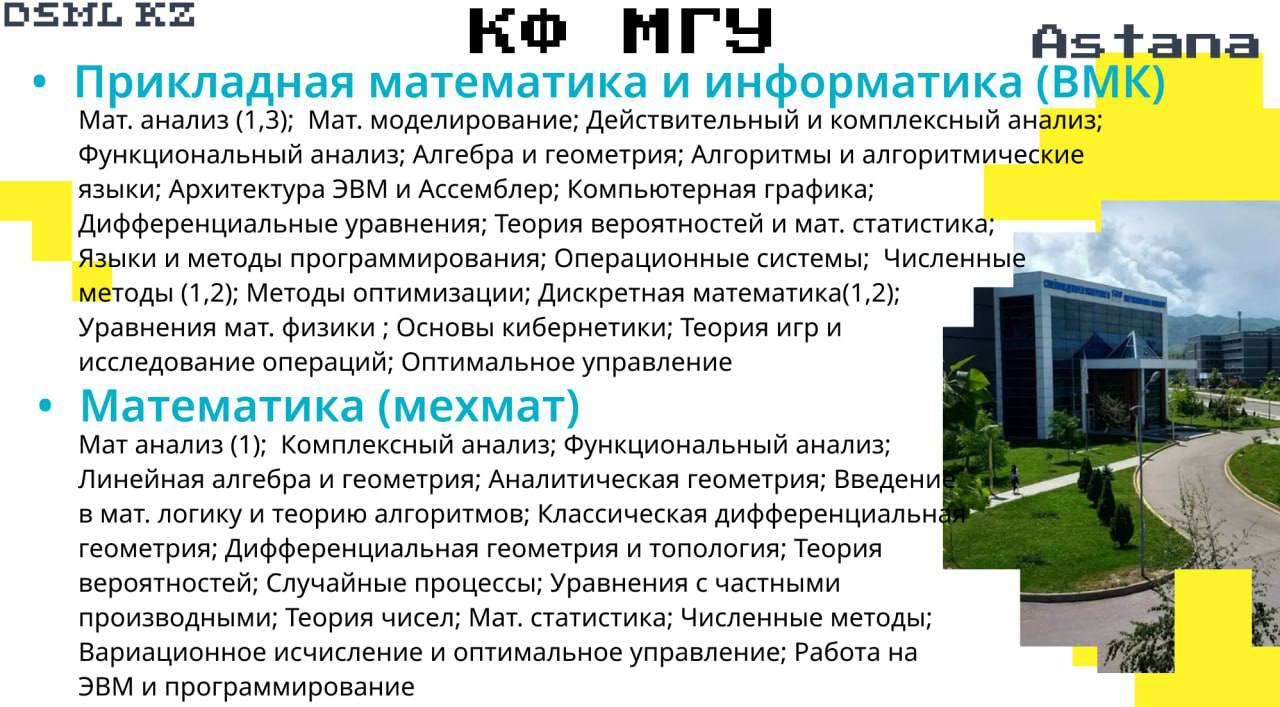
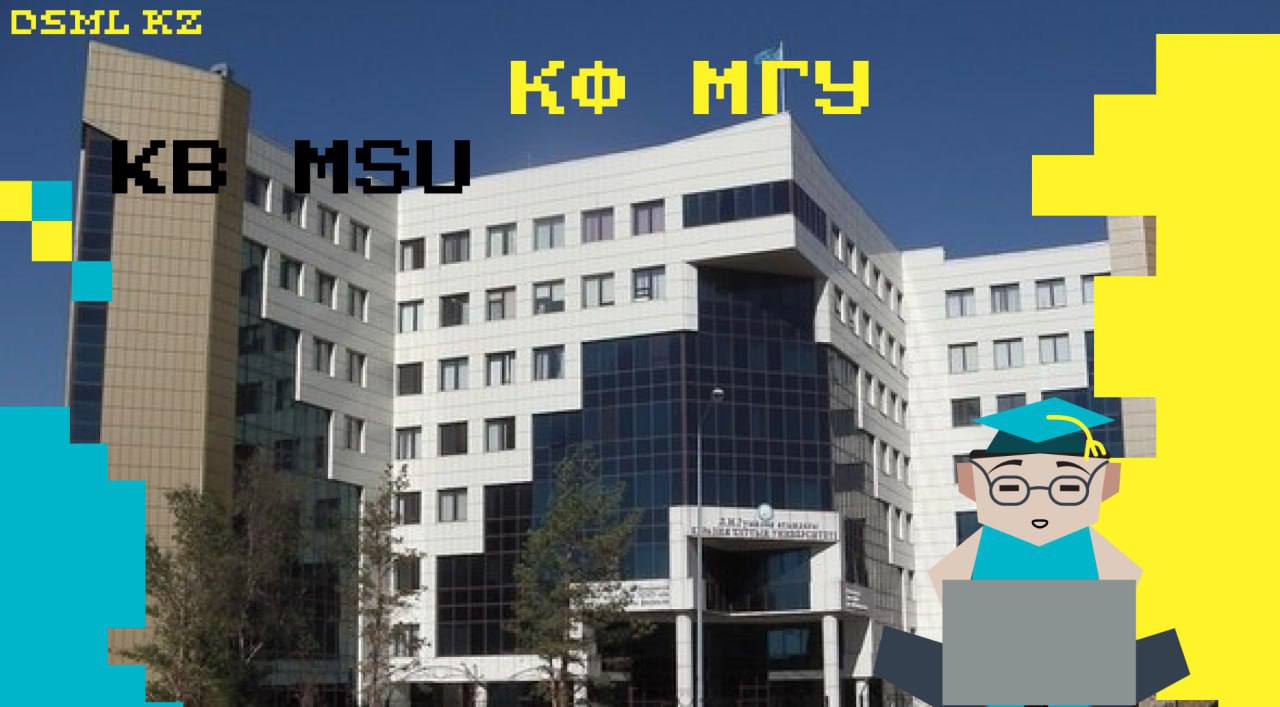
    We selected two programs at the MSU Kazakhstan Branch:

    • APPLIED MATHEMATICS AND COMPUTER SCIENCE, Faculty of Computational Mathematics and Cybernetics.

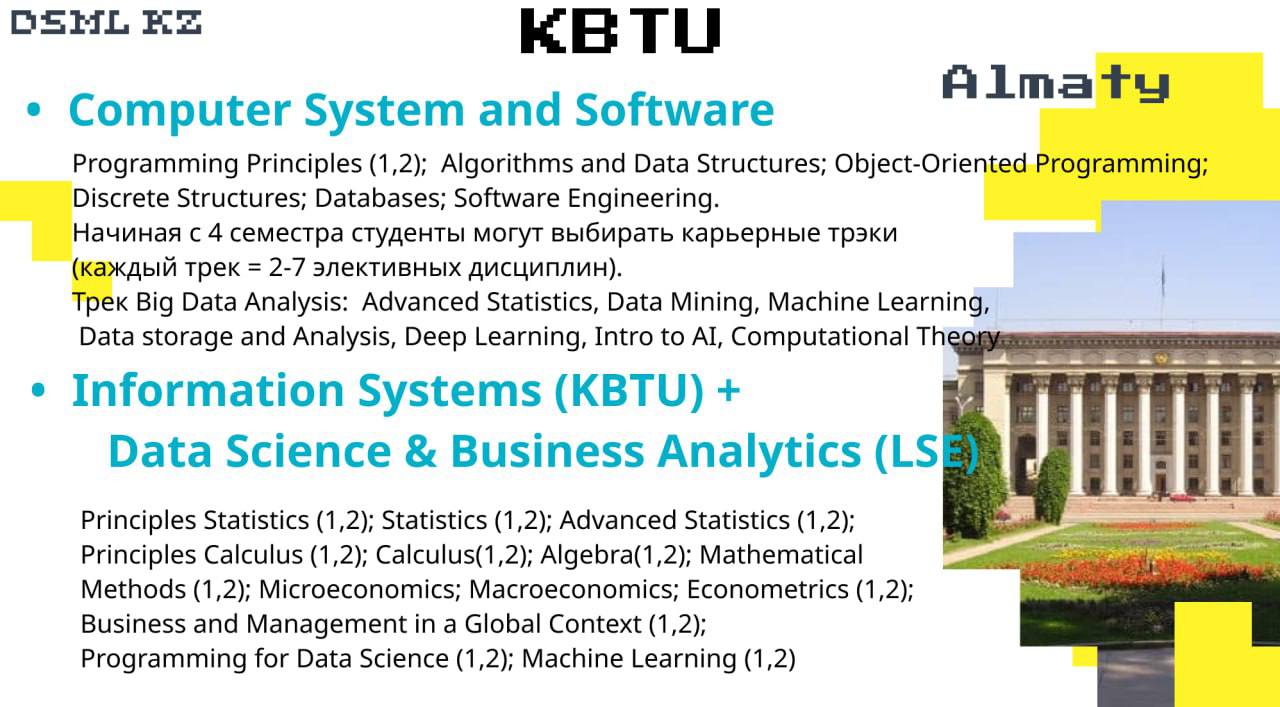
    The program focuses on applied mathematics. Core courses: Mathematical Analysis (1, 3); Mathematical Modeling; Real and Complex Analysis; Functional Analysis; Algebra and Geometry; Algorithms and Algorithmic Languages; Computer Architecture and Assembly Language; Computer Graphics; Differential Equations; Probability Theory and Mathematical Statistics; Programming Languages and Methods; Operating Systems; Numerical Methods (1, 2); Optimization Methods; Discrete Mathematics (1, 2); Equations of Mathematical Physics; Fundamentals of Cybernetics; Game Theory and Operations Research; Optimal Control.

    • MATHEMATICS, Faculty of Mechanics and Mathematics.

    The program places greater emphasis on classical mathematics. Core courses: Mathematical Analysis (1); Complex Analysis; Functional Analysis; Linear Algebra and Geometry; Analytic Geometry; Introduction to Mathematical Logic and Algorithm Theory; Classical Differential Geometry; Differential Geometry and Topology; Probability Theory; Stochastic Processes; Partial Differential Equations; Number Theory; Mathematical Statistics; Numerical Methods; Calculus of Variations and Optimal Control; Computer Work and Programming.

    Study format: Classes at the MSU Kazakhstan Branch are organized in blocks.

    • Depending on the course volume, two instructors from Moscow come once or twice per semester to deliver lectures and seminars.
    • A block lasts two weeks, during which students have four classes in that single subject each day—around 20 mathematical-analysis classes per week, for example.
    • Each block ends with a pass/fail assessment or an exam.
    • Between blocks, the timetable is lighter and consists mainly of humanities subjects.
    • From the third year, students move to Moscow and follow the regular study schedule there.

    Tuition information: Students at the MSU Kazakhstan Branch study on state-funded grants.

    Discuss · 00
    Telegram

    MSU Kazakhstan Branch: strengths and weaknesses

    Fresh news7 Jul 2023
    MSU Kazakhstan Branch: strengths and weaknesses

    The Kazakhstan Branch of Lomonosov Moscow State University (MSU Kazakhstan Branch) showed both strengths and weaknesses in the overall university ranking, according to survey data and student feedback.

    Strengths of the MSU Kazakhstan Branch:

    • A strong foundational education: The branch ranks first for the quality of foundational courses, while reviews mention a high standard of teaching and instructors who actively publish research.
    • Reputation: The university is valued for its brand and reputation, especially because of its connection to Moscow State University.

    Weaknesses of the MSU Kazakhstan Branch:

    • University cultural life is considered underdeveloped by respondents. This is reflected in its sixth-place survey ranking and reviews that mention few clubs and activities.
    • The quality of humanities courses needs improvement, according to reviews.
    • A lack of practical training is mentioned in reviews and reflected in the university's below-average third-place ranking for applied-course quality.

    Overall, the MSU Kazakhstan Branch has a strong academic reputation and solid foundational education, but needs to improve student cultural life, humanities education, and practical training.

    Discuss · 03
    Telegram

    Three AITU programs for data, software, and computational science

    Fresh news7 Jul 2023
    Three AITU programs for data, software, and computational science

    UNT subjects: Mathematics + Computer Science. The minimum UNT score to apply for a grant is 85.

    • BIG DATA ANALYSIS (6B06103)

    The program focuses on applied mathematics and data science. Core courses: Algorithms and Data Structures; Big Data and Distributed Algorithms; Probability and Statistics; Computational Mathematics; Discrete Mathematics; Mathematical Analysis (1, 2); Deep Reinforcement Learning; Statistics and Data Science (1, 2); Applied Machine Learning.

    • COMPUTER SCIENCE (6B06101)

    The program places greater emphasis on practical IT development. Core courses: Introduction to C++; Introduction to Python; OOP (Java); OOP (Python); Algorithm Design and Analysis; Advanced Databases (NoSQL); Computer Organization and Architecture; Operating System Fundamentals; Machine Learning Algorithms; Cloud Computing.

    • MATHEMATICAL AND COMPUTATIONAL SCIENCE (6B06106)

    The program covers foundational applied programming courses as well as adjacent theoretical subjects such as cell engineering and genetics. Core courses: Heterogeneous Parallelization; Finite Volume Method; Finite Element Method; PL/SQL Programming; Quantitative Analysis; Database Management Systems; Deep Reinforcement Learning; Fuzzy Logic; Biostatistics; Genetics; Stochastic Processes.

    Tuition information: Annual bachelor's tuition for the programs above is 2,500,000 tenge. The total cost for three years is 7.5 million tenge.

    Discuss · 00
    Telegram

    AITU: strengths and weaknesses

    Fresh news7 Jul 2023
    AITU: strengths and weaknesses

    Astana IT University (AITU) ranked fourth in most categories of the overall university ranking and last for university brand. The anonymous survey highlighted the following key features of AITU:

    Strengths of AITU:

    • Length of study: The three-year program is an advantage for those who want to enter the job market sooner.
    • Practical courses: The courses are up to date and focused on practical skills.
    • Networking: The university frequently organizes conferences and hackathons, creating many opportunities for career development and professional networking.

    Weaknesses of AITU:

    • Administration: Students report dissatisfaction with the administration and problems with feedback.
    • Faculty: Despite having qualified staff, students point to unprofessional conduct by some instructors.
    • Learning-space comfort: The university building gets very hot during summer. There has also been a reported case of a ceiling collapsing in a classroom.
    Discuss · 06
    Telegram

    Three IITU programs in data and computer science

    Fresh news5 Jul 2023
    Three IITU programs in data and computer science
    • DATA SCIENCE (6B06112)

    The program focuses on data science. Core courses: Intro to Python; Python for Data Analysis; Machine Learning; Intro to Data Science; Data Science: Advanced; Deep Learning; Nonlinear Extremal Problems.

    • COMPUTER SCIENCE (6B06101)

    The program places greater emphasis on practical IT development. Core courses: Programming Languages and Technologies; Compiler Development (1, 2); Programming with PL/SQL; Data Science and Machine Learning (1, 2, 3); SAS Programming (1); Data Science of Health Informatics (1, 2); Data Mining (1, 2); Functional Programming in Scala (1, 2).

    • BIG DATA ANALYTICS (6B06103)

    The program places greater emphasis on data analysis and business analytics. Core courses: OOP; Operating Systems; Design Patterns; Introduction to Python and Data Processing and Analysis Libraries; Big Data Collection and Storage; AWS Cloud Fundamentals; AWS Solution Architecture; Programming in PL/SQL (Oracle).

    Tuition information: Programs in the B057 Information Technology group cost 5,510,000 tenge in total over four years. Annual tuition varies by year of study: year 1 — 1,280,000 tenge; year 2 — 1,340,000 tenge; year 3 — 1,410,000 tenge; year 4 — 1,480,000 tenge.

    Discuss · 01
    Telegram
    PreviousPage 19 of 20Next