Latest news and updates from DSML Kazakhstan community
Stay up to date with the latest events
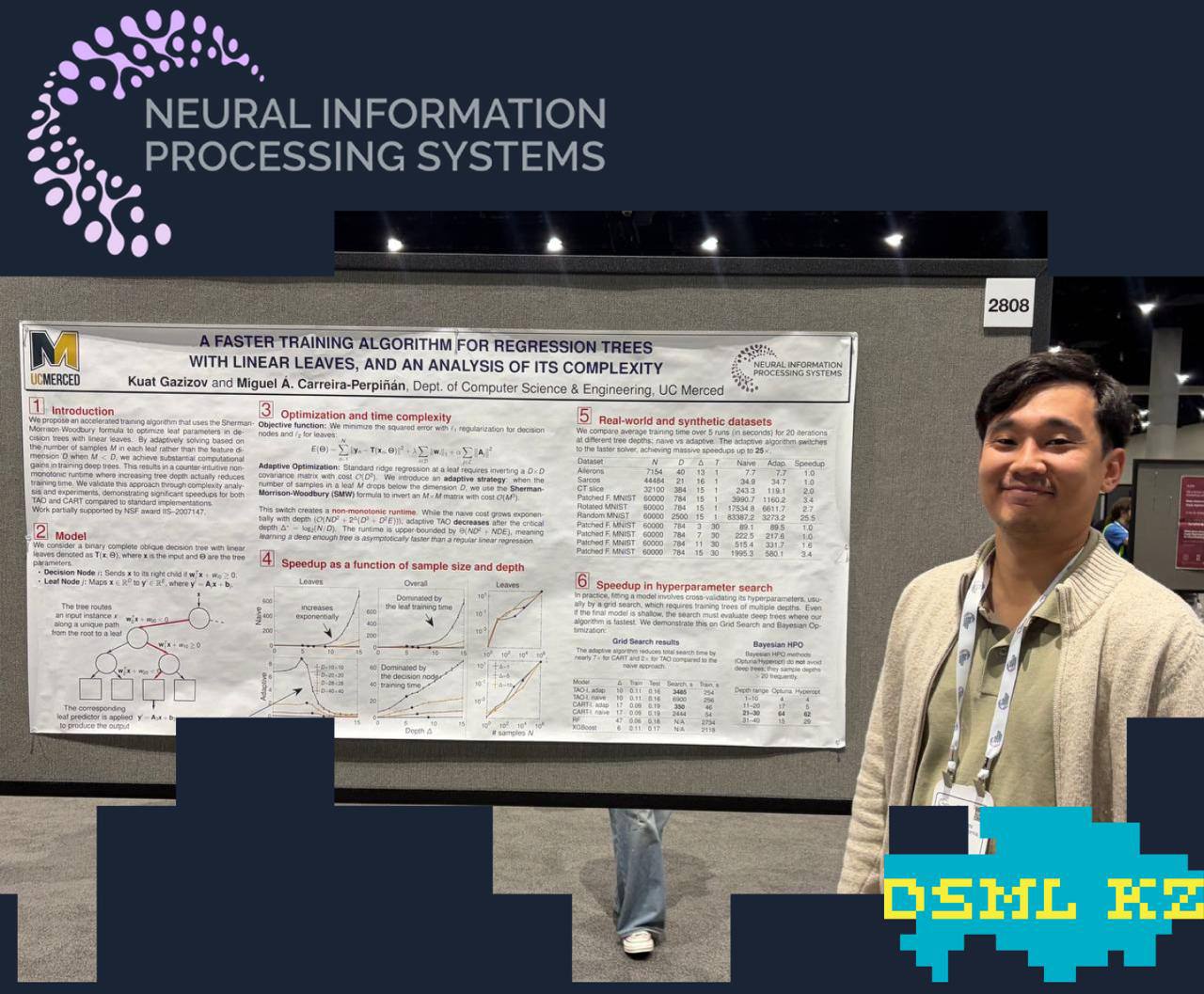
Kuat Gazizov, a PhD student at the University of California, Merced, presented “A Faster Training Algorithm for Regression Trees with Linear Leaves, and an Analysis of Its Complexity”. Kuat shows that Tree Alternation Optimization for regression trees can be accelerated substantially with the Sherman–Morrison–Woodbury formula while preserving accuracy. This lets deep trees train faster and potentially even outperform ordinary linear regression in training speed.
Congratulations to Kuat on a successful publication, and we wish him continued success in research!
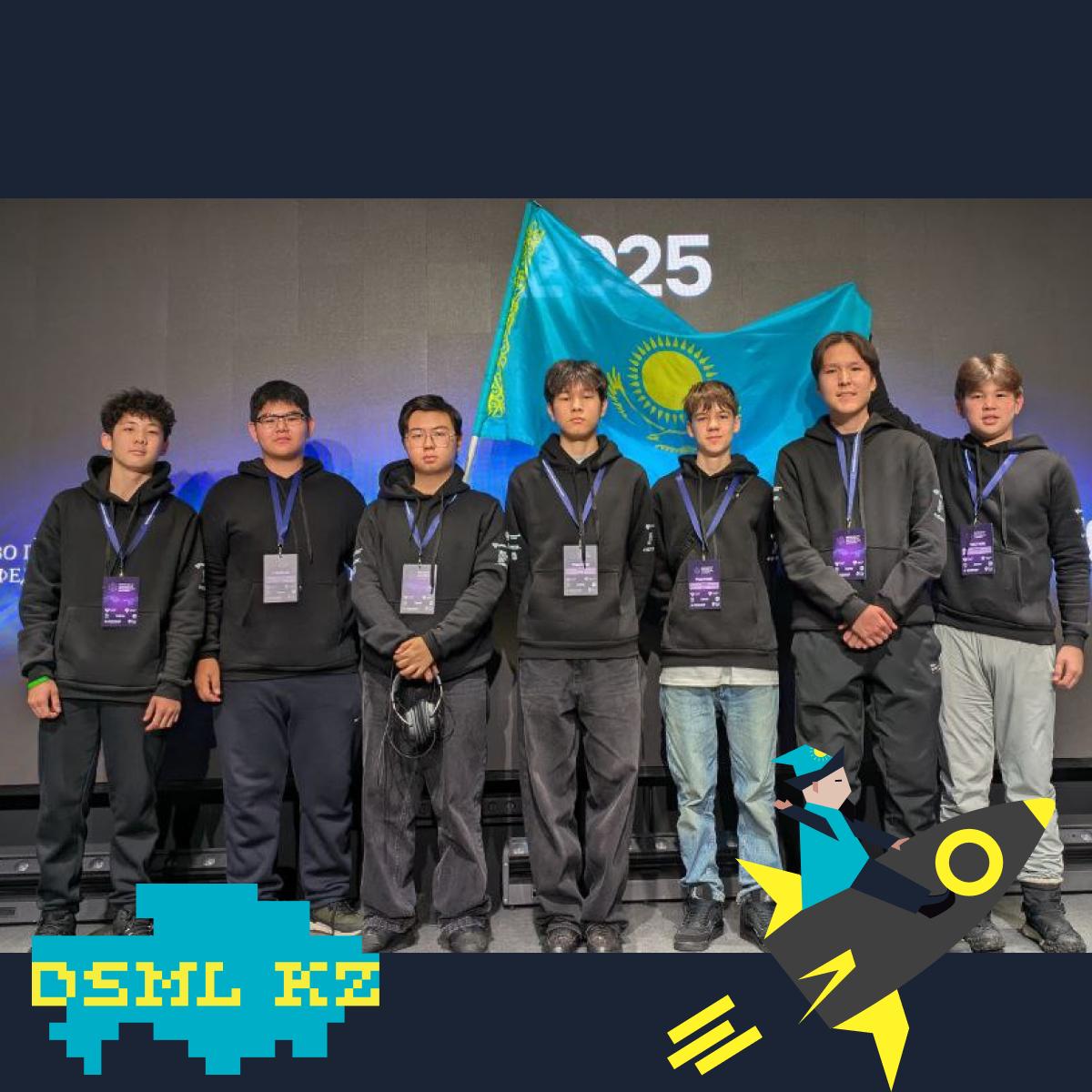
On November 22, Russia's national artificial intelligence olympiad for students in Grades 8–11 and international participants from Armenia, Uzbekistan, Cyprus, and Kazakhstan concluded. The olympiad initially registered 52,123 students. Sixty-two finalists met in Moscow for the final stage from November 17 to 22, which included an individual round with two problems and a team round.
Congratulations to our students on their excellent results:
We look forward to even more success from our young dsml.kz members!
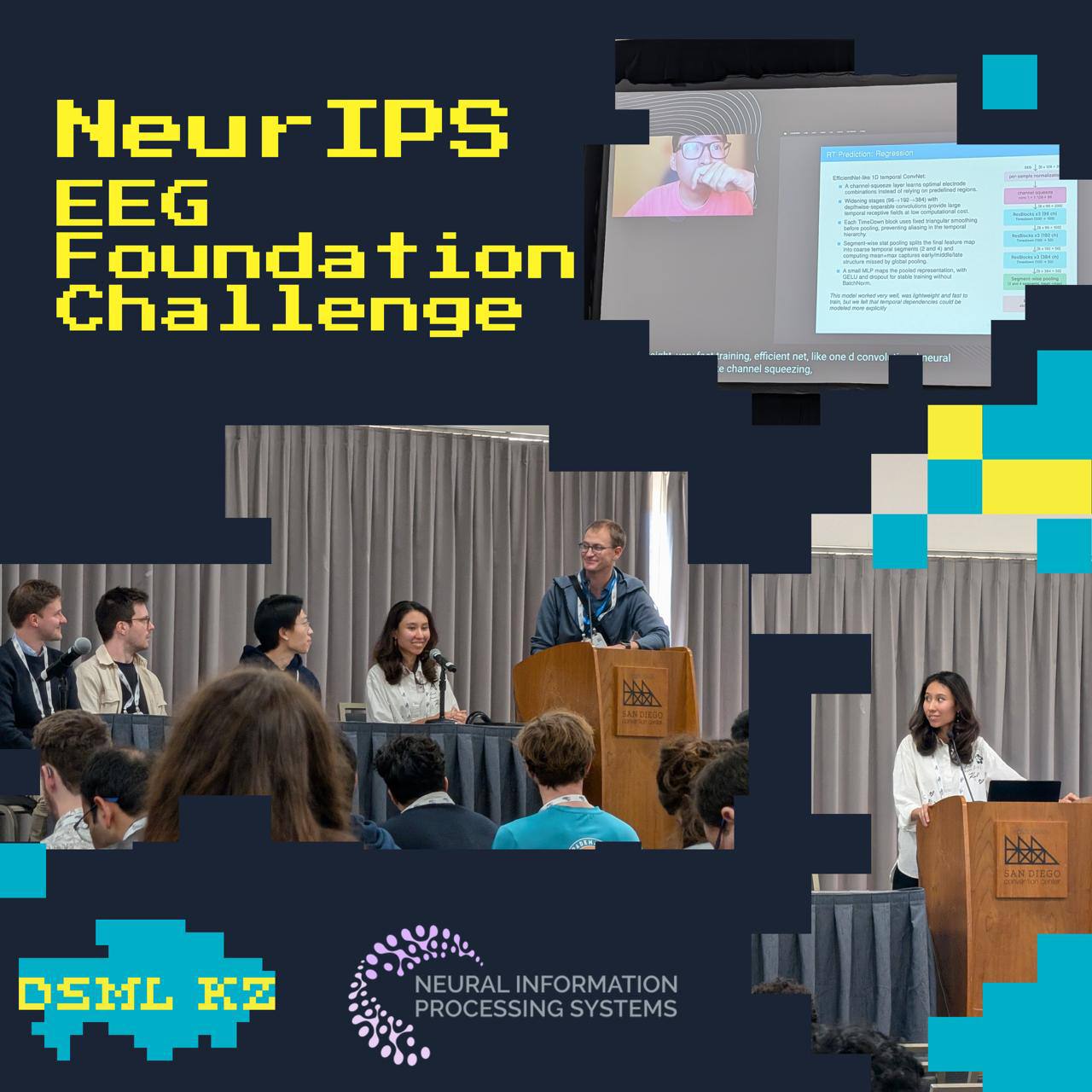
We are happy to share that our MBZUAI [dsml.kz] team—Anuar Aimoldin, Ayana Mussabayeva, and Yedige Mussabayev—placed first overall by the combined metric in the EEG Foundation Challenge at the NeurIPS Competition Track 2025!
The challenge had two tasks: 1️⃣ Predict reaction time from stimulus-dependent EEG; 2️⃣ Predict the externalizing factor from EEG, a psychometric characteristic representing the shared dimension of psychopathology across different disorders.
The final score combined the metrics from both tasks: 30% for Task 1 and 70% for Task 2.
As winners, we were invited to present our work at the NeurIPS 2025 Competition Track and the Workshop on Foundation Models for the Brain and Body.
🏆 Our solution is available as open source: https://github.com/sneddy/neurosned
Neurosned is a fully reproducible end-to-end training pipeline that includes helper scripts, our manually designed lightweight models, and Jupyter-notebook tutorials.
We hope the project is useful to researchers interested in neuroscience, BCI, or EEG modeling!
GitHub stars and LinkedIn likes are highly appreciated 😂
The hackathon attracted 900 teams from more than 30 countries. Finalists met in Abu Dhabi to build a project with the open 32B K2 Think language model in 48 hours. Teams included participants from Google DeepMind, Cornell University, Harvard Medical School, Hong Kong University of Science and Technology, MBZUAI, and others.
Kazakhstan's Axiom team won: Bakhyt Momunov, Nurmukhamed Zibatkaliyev, and Alexander Shakiyev.
Drawing on their mathematical-olympiad experience, the team built a Math Research and Proof assistant. They adapted K2 Think to automatically translate mathematical proofs from natural human language into formal, machine-readable Lean. Regardless of length or complexity, the formalized proof can then be checked precisely for logical validity and correctness.
Build a project using K2 Think, the open 32B reasoning model from MBZUAI and G42 designed for deep thinking. The hackathon has two stages:
Deadline: October 26 at 10:00 Astana time
The hackathon is open worldwide with no age restrictions. Finalists receive a travel grant of up to AED 20,000 per person for flights, accommodation, and meals.
Registration: hackathon.k2think.ai/#apply