Latest news and updates from DSML Kazakhstan community
Stay up to date with the latest events
The International Olympiad in Artificial Intelligence is one of the most prominent international AI olympiads for school students. This year, the location moved from Abu Dhabi to Astana—a major event for Kazakhstan.
Kazakhstan became one of the leading candidates to host the olympiad instead of the UAE largely because of the work and reputation of DSML residents Anuar Aimoldin and Nurdaulet Akhanov. Both serve on IOAI's international scientific committee and contribute to problem development and olympiad organization.
Last year, DSML and CPFED jointly ran Kazakhstan's first national AI olympiad and prepared the national team for IOAI. These were important first steps for school-level AI education in the country. We again thank the residents who developed the initiative with Anuar and Nurdaulet in 2025: Alen Bayev, Daniil Orel, and Assel Yermekova 🫶🏽
Stay tuned for IOAI 2026 news—there is much more ahead!
Speaker: Ivan Rodkin
At this meeting, Ivan will discuss memory for language models. We will examine three major papers and their core ideas; Ivan is the first author of two of them.
At the meeting, we will discuss:
Tuesday, February 3, 17:00 Kazakhstan time Google Meet: meet.google.com/rrn-enzr-chz
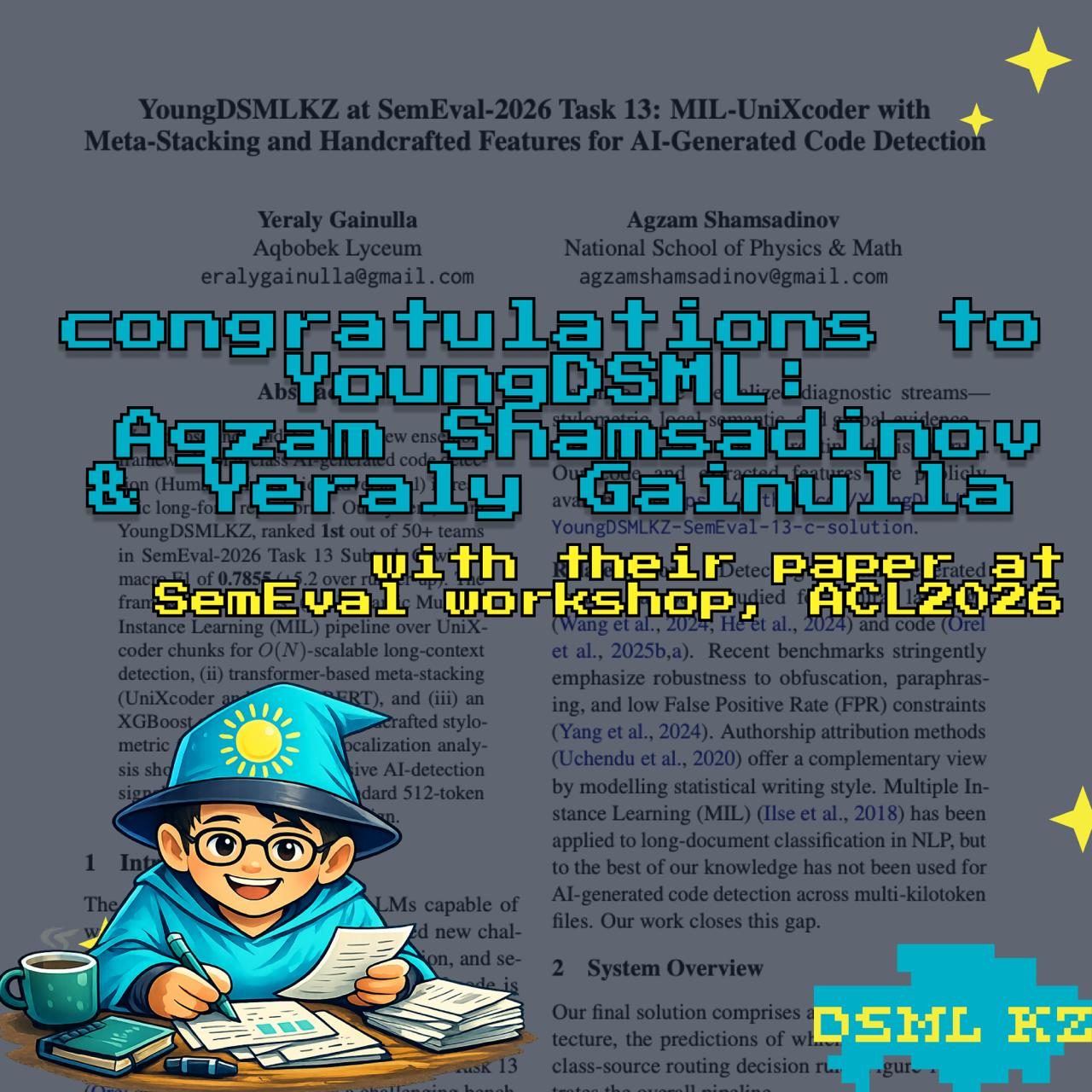
SemEval is an international series of NLP workshops and competitions. Task 13C classifies code authorship into four classes: Human, AI, Hybrid, and Adversarial AI.
Agzam and Yeraly built a multimodal ensemble that analyzes code from three perspectives: code semantics through UniXcoder with Multiple Instance Learning for long files; textual patterns through MazgaBERT, which identifies characteristic templates; and statistical anomalies through XGBoost using hand-crafted style and code-structure features.
Congratulations to our young residents, and we wish them many more victories!
Our community is especially proud that a team from Kazakhstan received a spotlight talk at the Foundation Models for Brain and Body workshop. Ayana presented the EEG Foundation Challenge solution in person in San Diego, while Anuar joined remotely because of visa difficulties.
The talk was followed by a panel discussion on the future of brain–computer interfaces and brain-activity analysis, moderated by Alex Gramfort, Research Science Director at Meta and one of the creators of scikit-learn.
📅 On Tuesday, December 16, at 12:00 Kazakhstan time, Ayana and Anuar will give a detailed walkthrough of their EEG Foundation Challenge solution: the architecture, data, key insights, and how it connects to practical machine learning. It will be a highly applied session for everyone interested in ML for neuroscience and biosignals.
Meeting link: meet.google.com/vie-gohs-wnr
Kuat Gazizov, a PhD student at the University of California, Merced, presented “A Faster Training Algorithm for Regression Trees with Linear Leaves, and an Analysis of Its Complexity”. Kuat shows that Tree Alternation Optimization for regression trees can be accelerated substantially with the Sherman–Morrison–Woodbury formula while preserving accuracy. This lets deep trees train faster and potentially even outperform ordinary linear regression in training speed.
Congratulations to Kuat on a successful publication, and we wish him continued success in research!